What Makes Some Herbal Remedies Work So Fast for Bloating?
What makes some herbal remedies seem to work so fast for bloating? The short answer is that the fastest-feeling effects are often less about “removing gas” and more about changing how the digestive tract contracts, moves contents, or interprets stretching. That is the central idea behind fast bloating relief herbal science: a botanical can produce a noticeable sensation change before it has materially changed the amount of gas or food inside the gut.
That distinction matters. Bloating is a symptom, not a single mechanical problem. A tight, distended feeling after a large meal can involve stomach accommodation, intestinal movement, trapped gas, visceral sensitivity, constipation, or several of these at once. An herb that relaxes intestinal smooth muscle may therefore feel helpful in one situation while doing little in another. The research is strongest for certain preparations of peppermint, while evidence for many other herbs remains smaller or more preliminary.
Could a bloated feeling change before the gas does?
Yes. The sensation of bloating does not necessarily track one-for-one with the physical volume of gas in the digestive tract. The gut contains stretch-sensitive nerves, smooth muscle, and coordinated motility patterns. When those systems change, the same amount of intestinal contents can feel different.
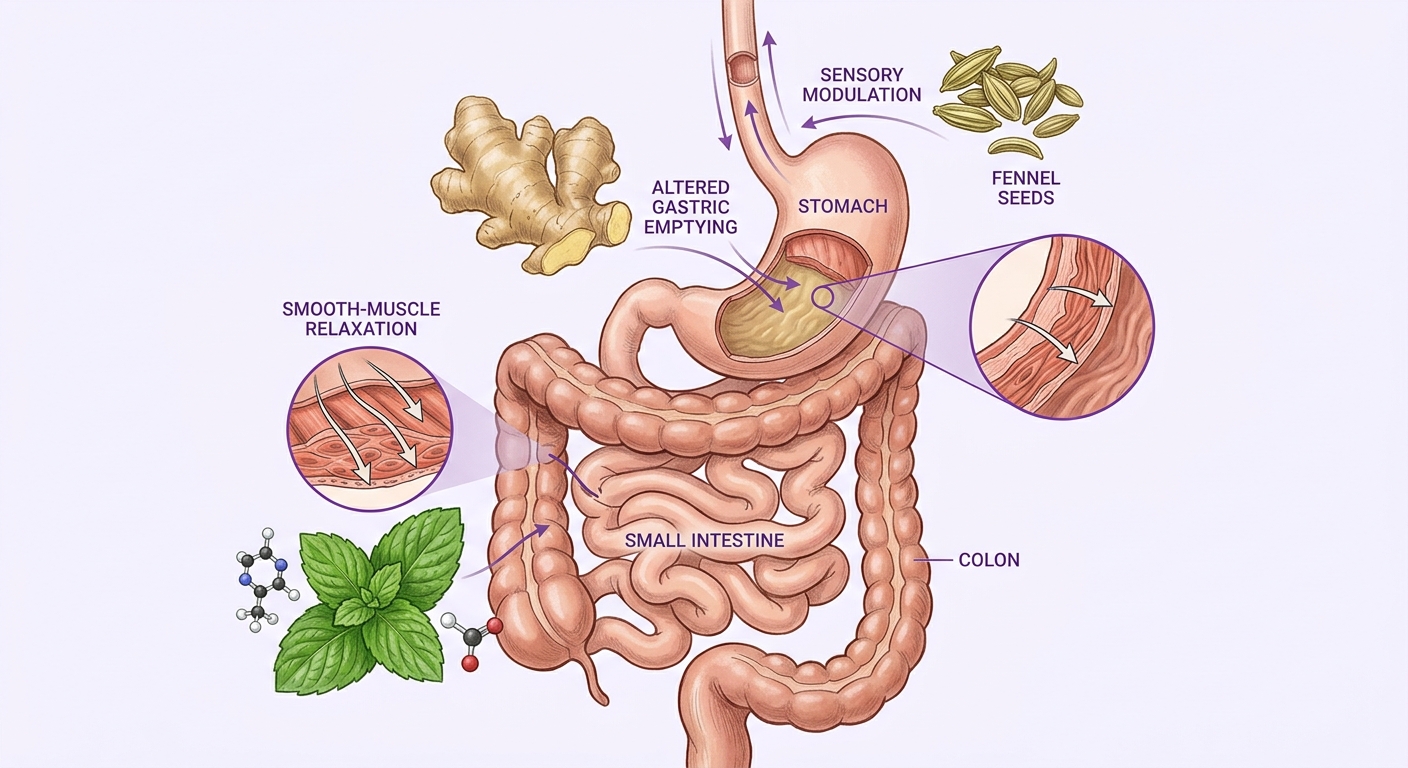
This is why a remedy can appear to work quickly without literally absorbing a large quantity of gas. If an intestinal segment is contracting unevenly, relaxing that muscle can change pressure and movement. If the stomach is slow to empty, influencing gastric motility can alter the sense of fullness. If the digestive tract is unusually sensitive to normal stretching, changing sensory signaling can alter discomfort even though the underlying contents have not instantly disappeared.
Why peppermint can feel unusually fast
Peppermint is the clearest example of why the phrase “fast relief” needs a physiological explanation. Its important constituent menthol has been studied for effects on gastrointestinal smooth muscle. Experimental research has found that peppermint oil and menthol can interfere with calcium-dependent contraction, while studies using human colon tissue have also found concentration-dependent reductions in contractile activity. In simple terms, less calcium entering smooth-muscle cells can mean less forceful contraction.
That mechanism is relevant because gastrointestinal muscle has to contract and relax in carefully timed patterns. Excessive or poorly coordinated contraction can contribute to cramping, pressure, and discomfort. Research on peppermint has therefore focused not only on the presence of gas but also on spasms and visceral sensation.
The proposed explanation is not limited to one molecular target. Reviews of peppermint physiology describe several possible actions, including smooth-muscle relaxation and effects on sensory pathways. This helps explain why peppermint smooth-muscle relaxation can feel like a change in pressure or cramping rather than a dramatic “gas removal” event.
There is human evidence, but it is not uniformly positive. Clinical studies and reviews suggest that enteric-coated peppermint oil can provide modest short-term improvement in some irritable bowel syndrome symptoms, including abdominal pain, bloating, and gas. At the same time, trials have produced mixed results, and the quality of evidence is not high enough to treat peppermint as a universal answer to bloating.
What is actually happening at the muscle-cell level?
One useful way to understand the mechanism is to start with calcium. Gastrointestinal smooth muscle contracts when intracellular calcium rises and activates the molecular machinery that generates force. Experimental work has found that peppermint oil and menthol can reduce calcium entry through channels involved in contraction. Human-colon experiments have similarly suggested L-type calcium-channel effects as part of menthol's spasmolytic action.
This does not mean that drinking mint tea delivers a pharmacological dose of menthol equivalent to a laboratory preparation. Dose, concentration, extraction method, absorption, and where the compound is released all matter. A tea made from peppermint leaves is chemically and pharmacologically different from a standardized peppermint-oil capsule.
That difference is one of the most important corrections to the common idea that “natural” means all forms of an herb work in the same way. The plant, the preparation, and the delivery site are part of the intervention. A compound that acts strongly in a concentrated oil may have a very different effect when consumed as a dilute infusion.
Why ginger can feel different from peppermint
Ginger provides a useful counterexample because it is not simply another peppermint-style antispasmodic. Ginger contains pungent compounds called gingerols, with 6-gingerol among its best-known active constituents. Human research has examined ginger in relation to upper-gastrointestinal motility rather than treating it as a generic “gas buster.”
In a small randomized study of people with functional dyspepsia, a dose of ginger accelerated gastric emptying compared with placebo. That finding suggests one possible route to faster comfort after eating: changing how quickly the stomach processes and passes its contents can influence fullness and upper-abdominal sensations.
The evidence is limited, though. A small gastric-emptying experiment cannot establish that ginger will rapidly relieve ordinary bloating in everyone. It also cannot tell us that every ginger drink, candy, powder, or extract produces the same physiological effect. The more defensible conclusion is narrower: ginger-related gastric emptying is a plausible mechanism that has been demonstrated in a controlled human experiment, but it should not be inflated into a universal promise.
Can fennel work through more than one digestive region?
Fennel is another useful example because digestive motility is not uniform from one region to another. Recent experimental research examining fennel tea found different effects in different parts of the stomach: relaxation in the fundus and corpus, alongside increased contractile amplitude in antral preparations. The work was conducted in isolated guinea-pig stomach tissue, so it is mechanistic evidence rather than proof of rapid relief in people.
The significance is conceptual. An herb does not necessarily have one simple instruction such as “speed digestion.” The digestive tract is a coordinated system with regions that perform different jobs. A preparation can relax one region while promoting movement in another, depending on the active compounds, concentration, tissue, and receptors involved.
This region-specific fennel motility finding also illustrates a broader scientific rule: laboratory physiology can explain why an effect is plausible without proving that a person will feel that effect after one cup of tea.
What about caraway and menthol combinations?
A particularly interesting clinical example involves caraway oil combined with L-menthol in a site-specific formulation for functional dyspepsia. In a randomized controlled trial, the active formulation produced a statistically significant reduction in post-meal distress symptoms at 24 hours compared with placebo.
That result is worth noticing, but it should not be simplified to “caraway works within 24 hours.” The study evaluated a specific formulation, a specific patient group, and defined symptoms. Delivery to a particular region of the digestive tract was part of the formulation's design. This is another reason that herbal science cannot be reduced to a list of plant names.
The lesson is that formulation can be as important as the ingredient. A botanical compound has to survive preparation, reach an appropriate location, interact with relevant tissue, and do so at a meaningful concentration. Those steps determine whether a mechanism observed in a laboratory has a chance to become a noticeable clinical effect.
Why “fast” does not necessarily mean “strong”
A fast sensation change and a large therapeutic effect are different things. If an herbal preparation reduces a brief intestinal spasm, the resulting comfort may be noticeable relatively quickly. That does not mean it has corrected constipation, changed the underlying diet-related fermentation process, or eliminated a chronic cause of recurrent abdominal distension.
There is also a perception component. Digestive symptoms are strongly influenced by how the nervous system processes signals from the gut. A change in sensory signaling can alter discomfort without requiring a large change in the physical contents of the intestine. Peppermint research is particularly relevant here because proposed mechanisms include both effects on smooth muscle and modulation of visceral sensitivity.
So if a person feels better shortly after a herbal preparation, several interpretations are possible. The remedy may have changed motility or muscle tone. It may have influenced sensory signaling. The original discomfort may simply have been transient and resolving naturally. Or several factors may have occurred together. A single episode cannot establish which explanation is correct.
A practical way to apply the science
The most useful question is not “Which herb is strongest?” It is “What type of digestive problem seems to be happening, and does the proposed mechanism fit it?” That is conditional reasoning rather than a one-size-fits-all remedy claim.
If the main sensation is brief cramping, a mechanism involving smooth-muscle relaxation is more relevant than a claim about “detoxing” the gut. If the main problem is persistent fullness after meals, motility and gastric accommodation become more relevant. If symptoms recur frequently, the priority shifts from finding a fast sensation change to identifying why the symptoms keep returning.
For a non-concentrated preparation, someone might encounter peppermint tea bags, peppermint loose leaf tea, or a simple loose leaf herbal tea infuser. A ginger preparation may involve fresh ginger root or ginger tea bags, while fennel is commonly prepared from fennel seeds. These forms should not automatically be assumed to have the same dose or effect as concentrated oils studied in clinical research.
Simple preparation equipment such as a stainless steel tea infuser, mesh tea strainer, ginger herbal tea strainer, or fennel infusion tea filter changes convenience, not the underlying biology. Likewise, a peppermint herbal tea infuser bottle is simply a preparation vessel; portability should not be confused with greater efficacy.
What if the bloating keeps coming back?
Recurring symptoms change the decision logic. If an occasional episode follows an unusually large meal and settles, short-term comfort measures may be reasonable for many otherwise healthy adults. If the same symptom appears repeatedly, however, repeatedly suppressing the sensation can obscure the pattern that deserves attention.
A digestive symptom diary or bloating symptom tracker can help organize observations such as meal timing, bowel movements, constipation, diarrhea, abdominal pain, and symptom duration. A bloating food and symptom journal can also make it easier to see whether the episodes cluster around particular meals or circumstances. This is not a diagnostic tool, but it can turn a vague recurring complaint into a more useful history for a clinician.
If comfort is the immediate goal while the cause remains unclear, non-herbal measures can also be considered. A reusable hot water bottle or warm abdominal compress may provide warmth and comfort without relying on a botanical mechanism. A reusable warm compress wrap serves the same general supportive role. These approaches do not prove that the bloating is caused by muscle spasm, and they should not be presented as treatments for an underlying disease.
When the quick remedy is the wrong answer
Here is the important exception: if bloating is accompanied by severe or worsening abdominal pain, repeated vomiting, gastrointestinal bleeding, unexplained weight loss, fever, marked abdominal swelling, inability to pass stool or gas, or other concerning symptoms, the question is no longer which herb acts fastest. Those patterns warrant medical assessment.
There is another less dramatic counterexample. Suppose someone has recurrent bloating because of constipation. A substance that temporarily relaxes intestinal muscle may change the sensation without addressing the retained stool. If the underlying issue is a food intolerance, an altered bowel pattern, or another gastrointestinal condition, symptom relief alone may not solve the recurring problem.
The same principle applies to reflux. Peppermint may make a person with abdominal cramping feel better while simultaneously aggravating heartburn. In that situation, the mechanism that looks attractive on paper becomes a poor match for the individual's symptom pattern.
What should you remember about fast herbal relief?
Practical action checklist
- Identify the dominant sensation first: pressure, cramping, fullness, gas, constipation, or reflux.
- If the symptom is mainly cramping, consider whether a smooth-muscle mechanism actually fits the pattern.
- If the symptom is mainly post-meal fullness, remember that gastric emptying and accommodation are different physiological questions.
- Distinguish peppermint leaf tea from concentrated peppermint oil; the preparations are not equivalent.
- Do not assume that a rapid sensation change means the underlying cause has been corrected.
- If symptoms recur, record timing and associated bowel changes instead of repeatedly escalating herbal products.
- If a remedy causes reflux, burning, worsening pain, or another new symptom, stop treating the reaction as evidence that the remedy is “working.”
- Seek professional assessment when symptoms are persistent, severe, unexplained, or accompanied by warning signs.
Frequently asked questions about herbal bloating relief
1. Does peppermint actually remove gas?
Not necessarily. The more defensible explanation is that peppermint oil can affect gastrointestinal smooth muscle and sensory signaling. A reduction in spasm or discomfort can feel like gas has “moved” or disappeared, even when the mechanism is not direct gas removal.
2. Why can peppermint feel faster than a dietary change?
A dietary change may alter fermentation, stool patterns, or another underlying process over hours or days. A compound that directly influences smooth-muscle activity or sensory signaling can potentially change a sensation sooner. That does not make it more effective for the underlying cause.
3. Is ginger mainly a gas remedy?
No. Ginger has been studied for effects on upper-gastrointestinal motility, and a small randomized study found faster gastric emptying after ginger. That makes motility a more useful scientific description than calling ginger a generic gas-removing herb.
4. Does fennel have strong clinical evidence for bloating?
The evidence is much less established than the popular reputation of fennel might suggest. Recent experimental work provides interesting clues about region-specific effects on stomach motility, but laboratory findings are not the same as proof of rapid symptom relief in humans.
5. Can herbal tea work as quickly as herbal oil?
There is no universal answer. Tea and oil can contain different concentrations and different chemical profiles. A clinical trial of a concentrated or standardized preparation should not automatically be used to predict the effect of a cup of tea made from the same plant.
6. Why does peppermint sometimes make bloating feel worse?
One important reason is reflux. Peppermint can cause or worsen heartburn in some people. If upper-abdominal discomfort is actually related to reflux, a peppermint preparation may be a poor physiological match even if peppermint can relax intestinal smooth muscle.
7. Does fast relief prove that an herb is effective?
No. Symptoms can fluctuate naturally, and expectation can influence how discomfort is perceived. Controlled trials are needed to separate a genuine treatment effect from placebo effects and normal symptom variation.
Conclusion: speed comes from matching mechanism to symptom
The science behind fast-feeling herbal bloating relief is less mysterious than the marketing language often makes it sound. Some botanical compounds interact with digestive smooth muscle, calcium-dependent contraction, gastric motility, or sensory pathways. Those actions can plausibly change pressure, cramping, fullness, or discomfort before the physical contents of the gut have substantially changed.
Peppermint provides the clearest example, with evidence for smooth-muscle and sensory effects but also meaningful limitations and reflux-related trade-offs. Ginger points toward gastric motility. Fennel demonstrates that botanical effects can differ by digestive region. Caraway-and-menthol research shows how formulation and delivery can matter as much as the plant name on the label.
The most useful takeaway is therefore conditional: if the bloating sensation is driven partly by spasm or altered motility, a botanical that affects those pathways may produce noticeable comfort relatively quickly; if the symptom comes from a recurring underlying problem, fast comfort does not equal a complete solution. Understanding that difference turns herbal digestive aids from a vague promise of “quick relief” into a more realistic question of physiology, evidence, preparation, and fit.


Comments
Post a Comment